
VESPER by obiWAN® & Ocutune
Biodiversity-aware Zhaga outdoor lighting controller
VESPER is a Zhaga outdoor lighting controller with a built-in biosensor, developed with Ocutune. It measures how artificial light is experienced by nocturnal wildlife, plants and people, places every luminaire on biodiversity and light pollution maps and rates it against six Biodiversity & Light Impact Indexes. Cities can finally prove, not just promise, that their lighting respects the night.
Measure. Diagnose. Track. Act.
Product Overview
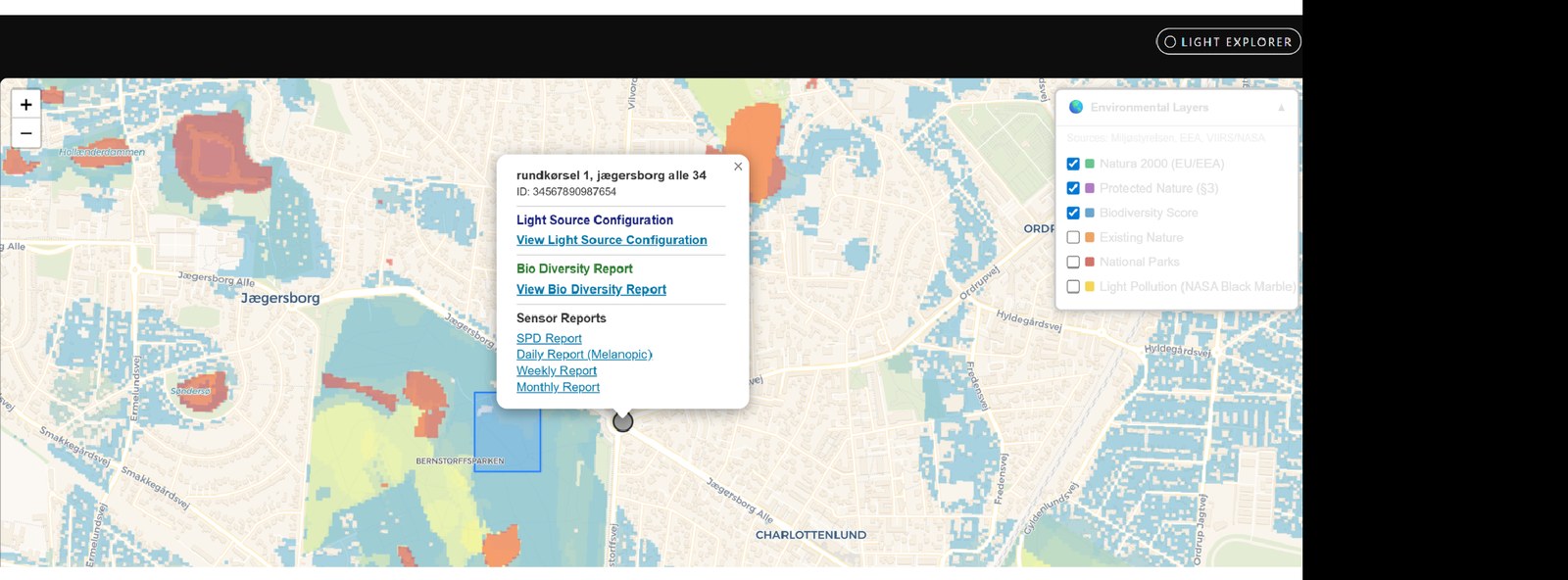
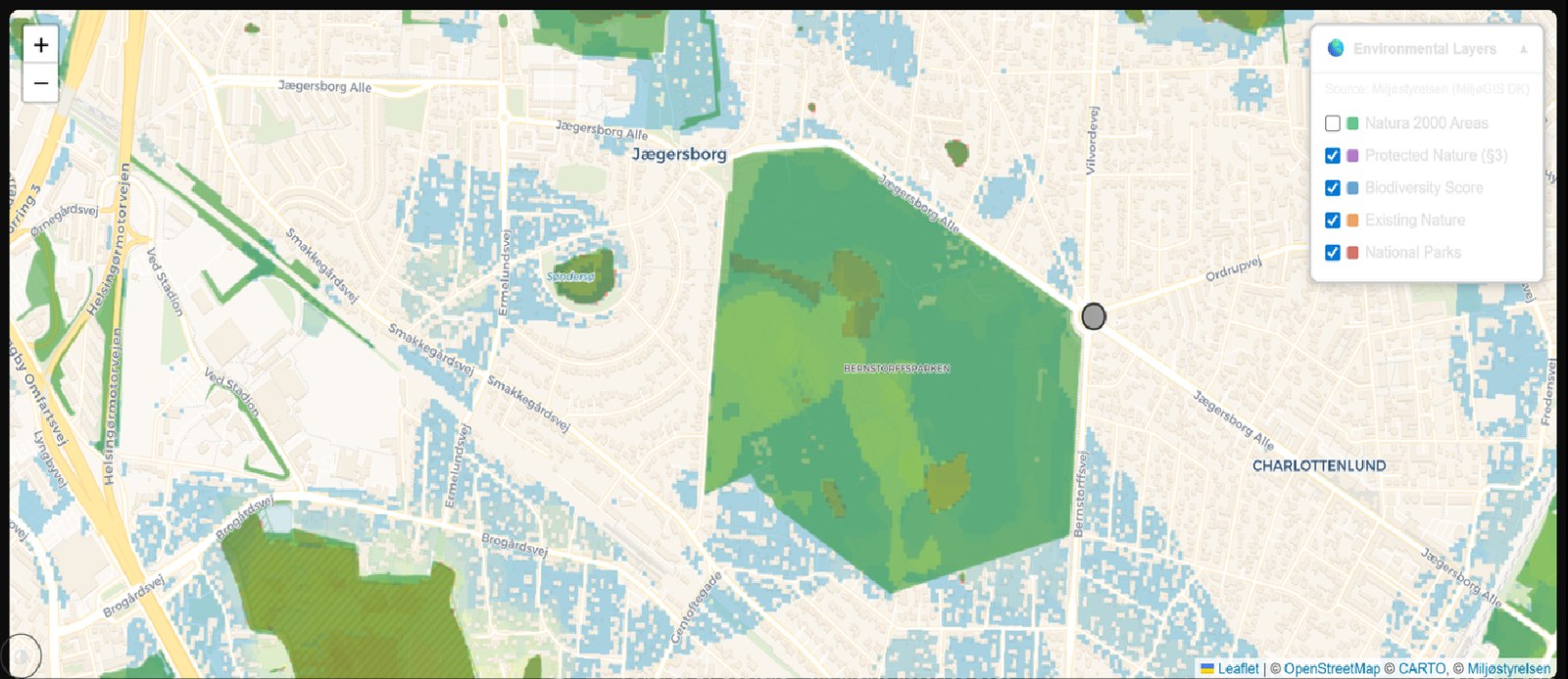
The VESPER platform places every luminaire on the maps that matter for biodiversity, Natura 2000 sites, protected nature, biodiversity score and the NASA Black Marble light pollution map, tags it with its environmental zone (E0 to E4, CIE 150) and sky brightness (SQM), and rates it against six Biodiversity & Light Impact Indexes. The result is a clear, actionable framework to protect ecosystems and restore natural darkness, luminaire by luminaire.
The Six Biodiversity & Light Impact Indexes
• Index 2, Insect Attraction Index (IAI): Donners-style attraction from UV, blue and green spectral bands, intensity, flicker, presence sensor and ULOR
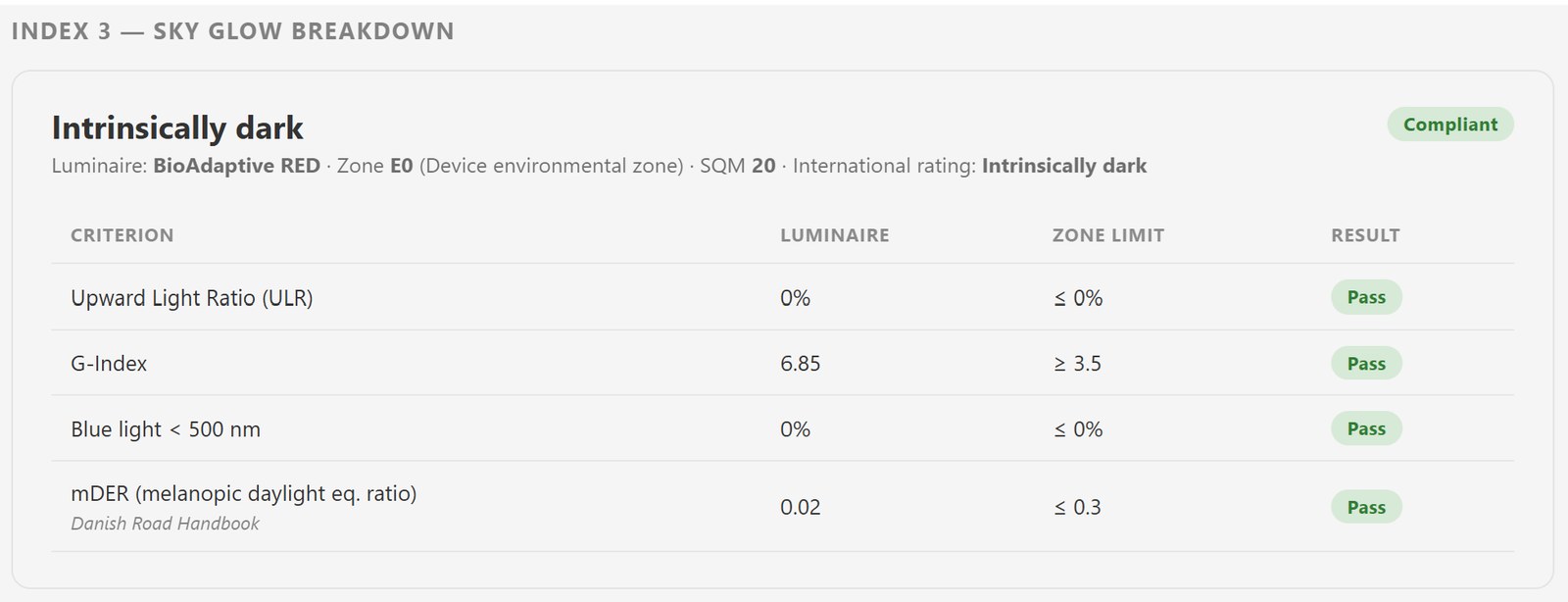
• Index 3, Spectral G-Index, sky glow contribution: rated against the environmental zone (CIE 150, Danish Road Handbook), with ULR, blue light below 500 nm and mDER
• Index 4, Bat Habitat Disruption (EUROBAT): impact on bat foraging and commuting from intensity, spectrum, UV, light below 560 nm, flicker, shielding and timing
• Index 5, Flora Photoperiod Interference (TPII): tree photoperiod disruption from red and blue spectral load against a full-moon baseline, adjusted for curfew, presence, ULOR and BUG
• Human factors, Circadian / Sleep: night-time melatonin-suppression risk from melanopic EDI, S-cone EDI and UV
Each index returns Compliant or Non-compliant and names the criterion that failed.
Platform Features
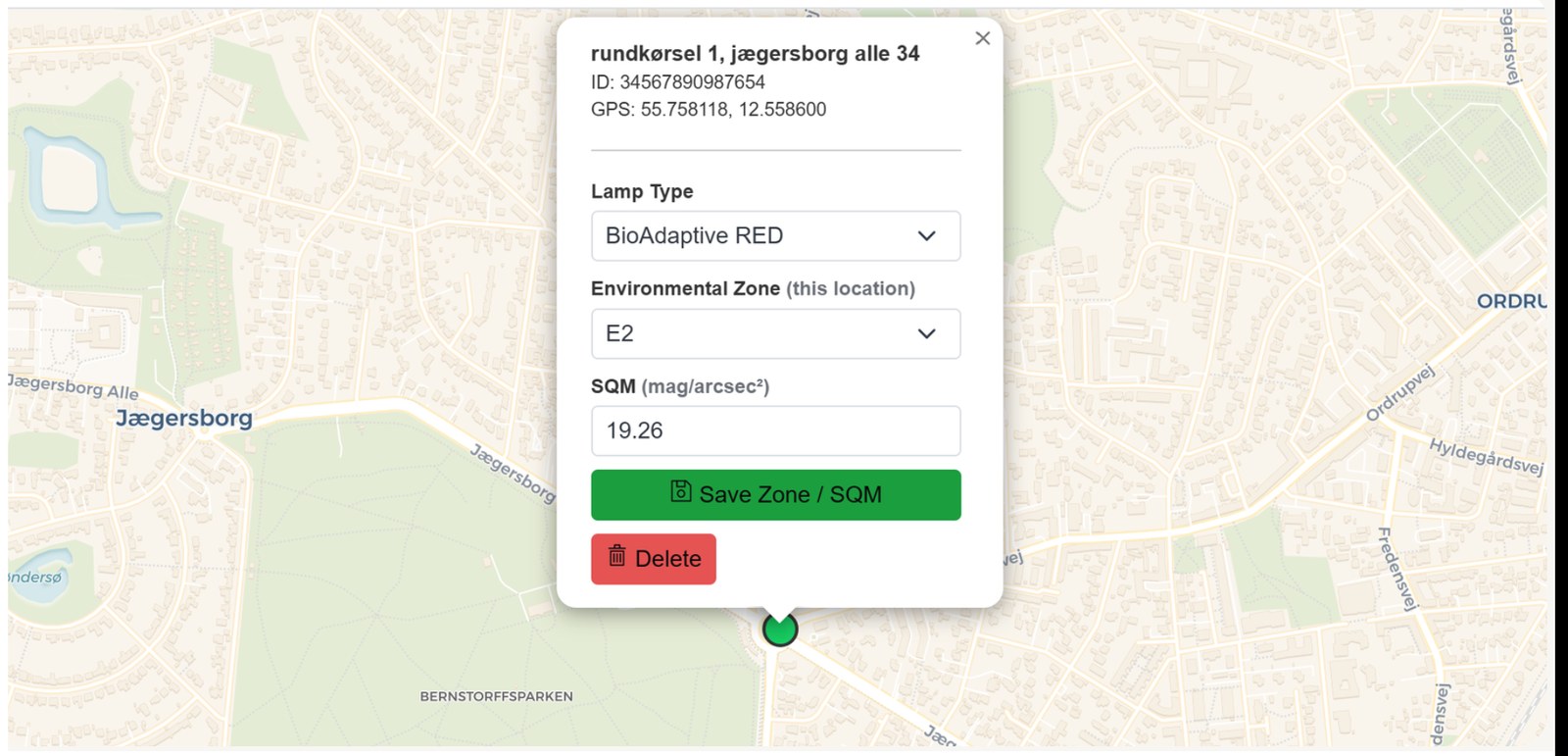
• Environmental zone per luminaire, E0 intrinsically dark to E4 urban centre, according to CIE 150
• SQM sky brightness value per luminaire, in mag/arcsec²
• Dark corridors drawn on the map, with the luminaires inside tagged and rated against the corridor thresholds
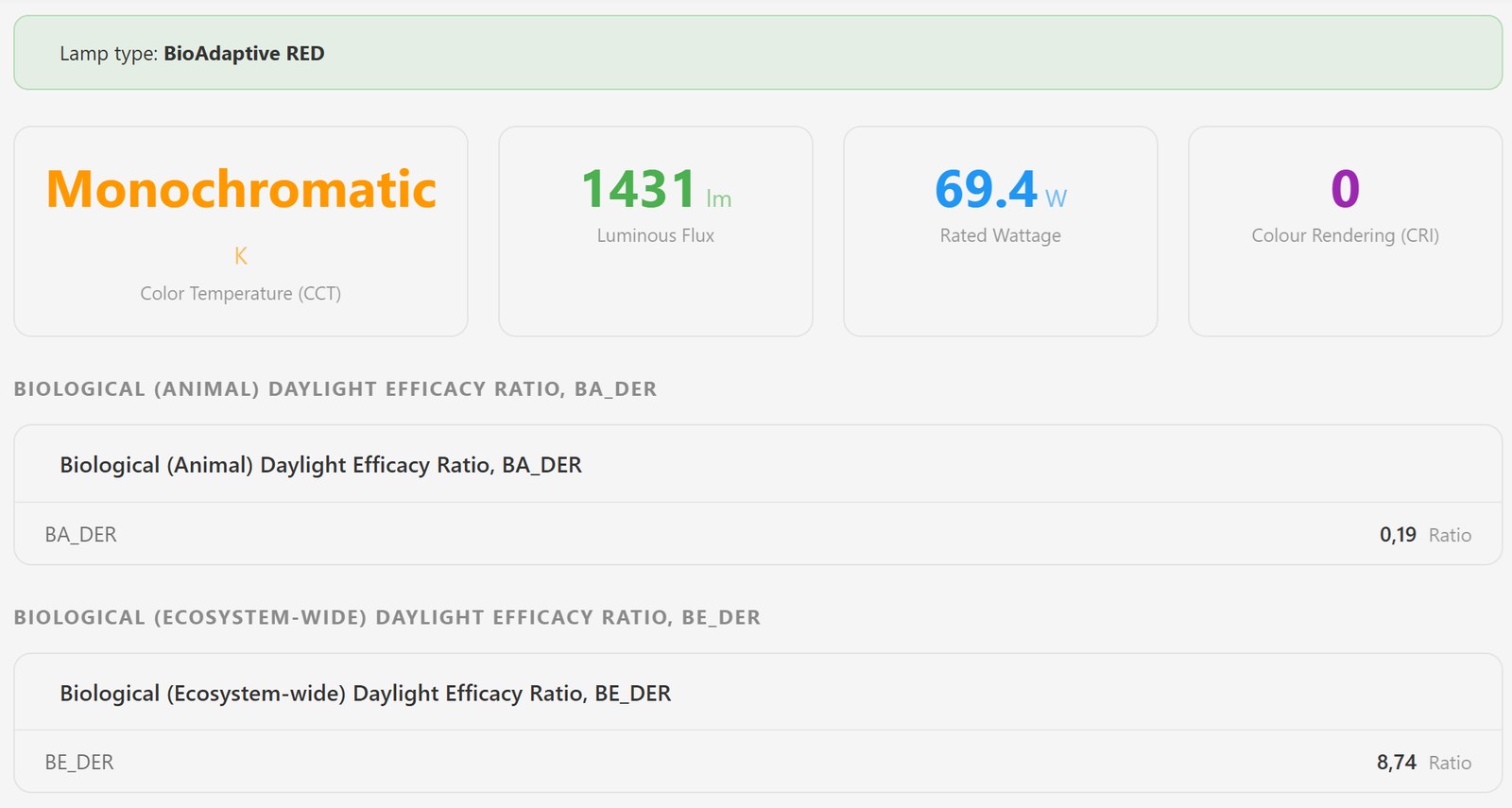
• Lamp type and spectrum profiles, with CCT, luminous flux, rated wattage, CRI and biological daylight efficacy ratios
• Sensor reports: SPD report, daily melanopic report, weekly and monthly reports
• Biodiversity report per luminaire with the mitigation measures that matter for each index
Typical Applications
Meet VESPER
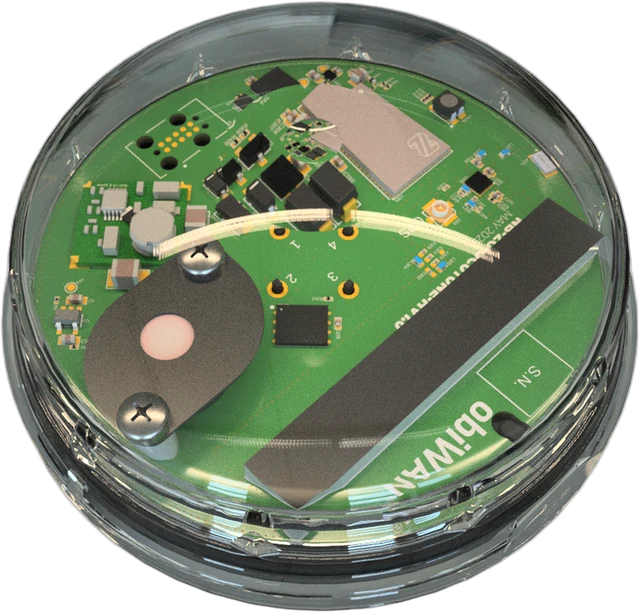
A standard Zhaga socket on top of the luminaire carries a state of the art biosensor that reads the light the way nature experiences it.
Spectral power distribution, melanopic load, intensity, flicker and UV, recorded on the pole instead of estimated from a datasheet.
Every luminaire is placed on Natura 2000, protected nature, biodiversity score and NASA Black Marble light pollution layers.
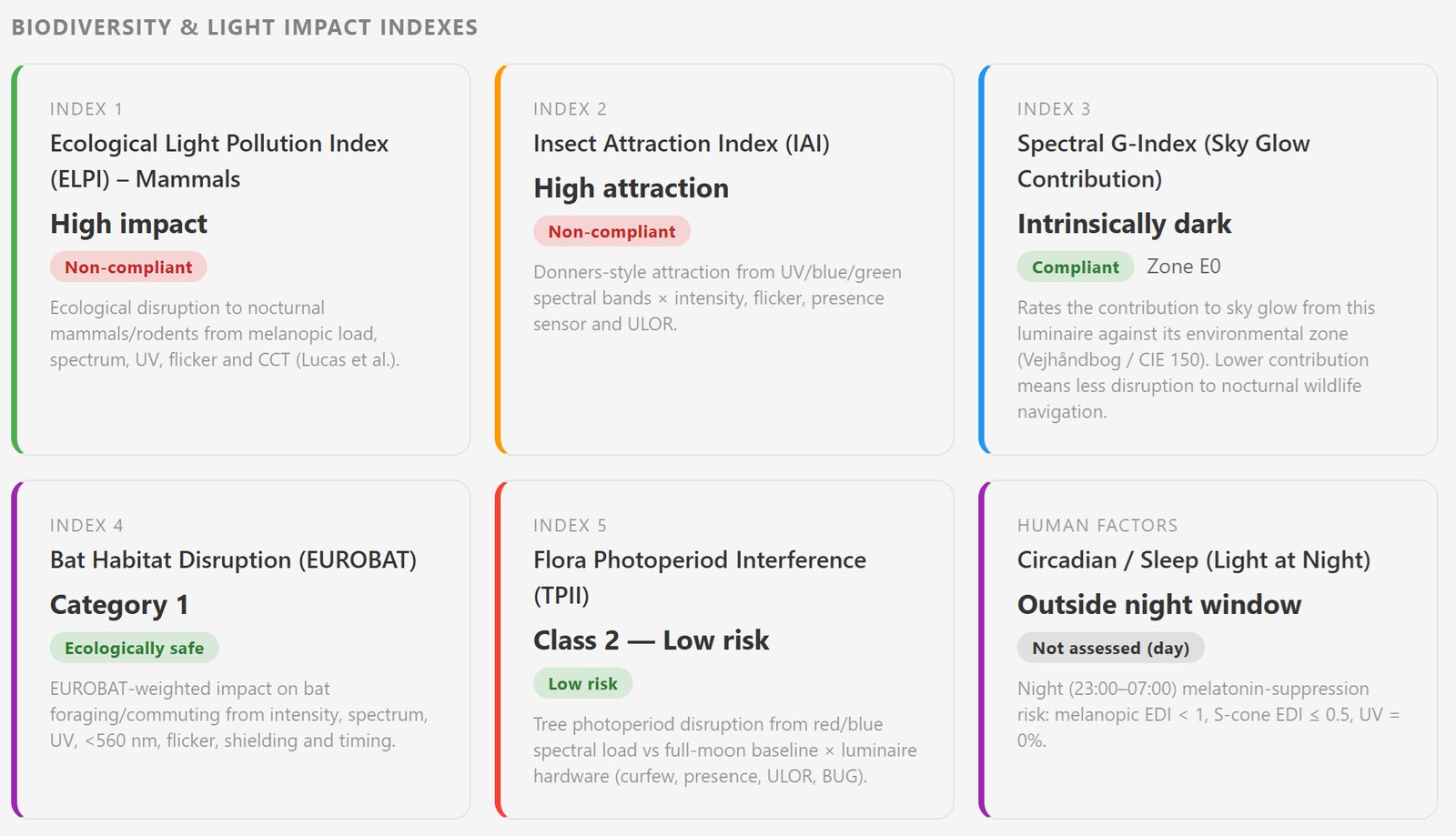
Each luminaire is rated for mammals, insects, sky glow, bats, flora and human sleep, with a Compliant or Non-compliant result.
The night, measured.
Artificial light at night is one of the fastest-growing ecological pressures. VESPER gives municipalities, utilities and environmental agencies a science-based way to measure, mitigate and reduce its impact on biodiversity and on the night sky.
Each luminaire is tagged with its CIE 150 zone, from E0 intrinsically dark to E4 urban centre, and an SQM sky brightness value in mag/arcsec².
Draw dark corridors on the map, tag the luminaires inside them and set the dark sky thresholds the lighting has to respect.
SPD report, daily melanopic report, weekly and monthly reports, per luminaire and per zone, ready for environmental audits.
Compare lamp types and spectra, such as a monochromatic red profile with 0% blue content, against the limits of each zone before you buy.
Built for bio-aware cities
VESPER turns biodiversity protection into something a lighting operator can measure, report and improve, luminaire by luminaire.
Evidence for Tenders and Audits
Per-luminaire ratings against CIE 150 environmental zones, ready to include in environmental reports and in the biodiversity criteria of public tenders.
Darker Skies, Same Safety
Dim, change the spectrum or set a curfew only where the indexes show an impact, keeping full light where traffic and people need it.
Natura 2000 Aware Lighting
See exactly which luminaires stand inside or beside protected habitats, bird protection areas and bat corridors.
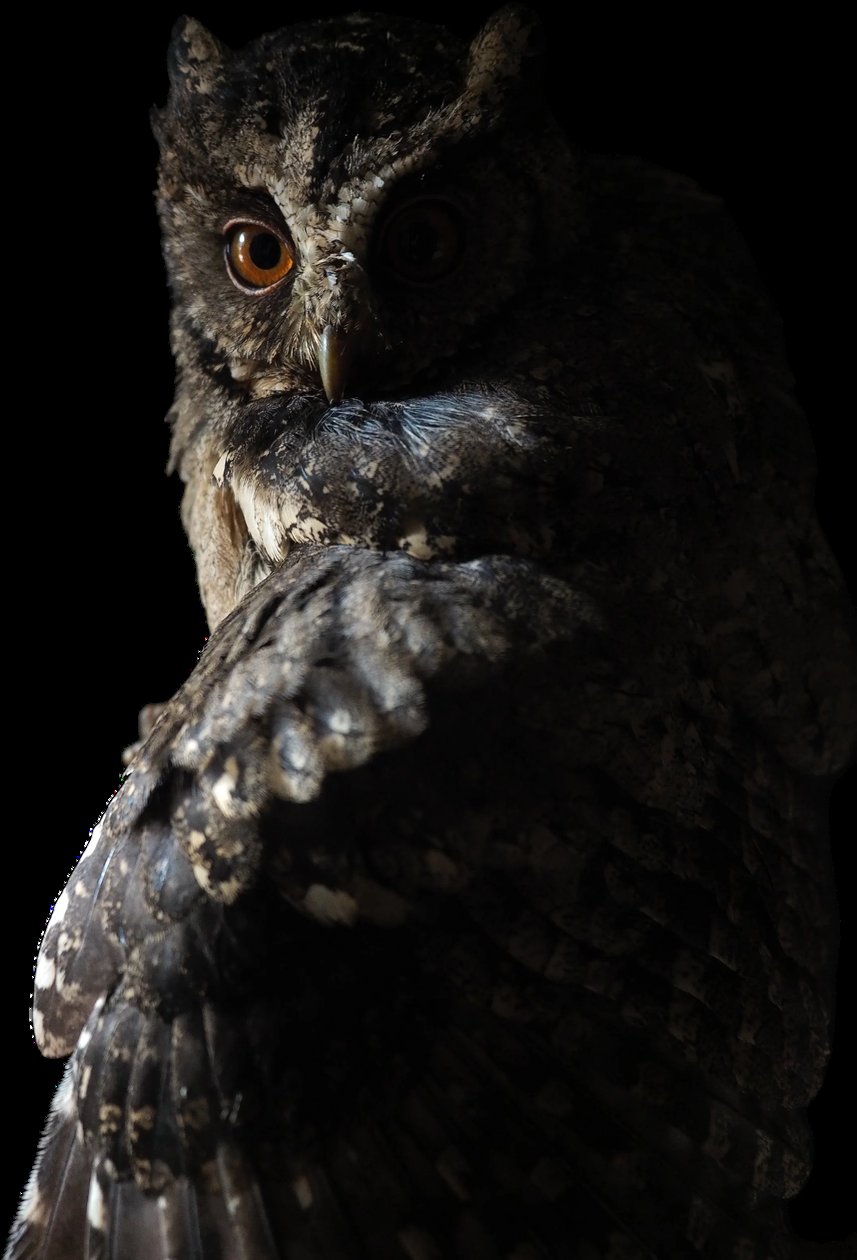
Bats, Insects, Flora
EUROBAT-weighted bat index, Donners-style insect attraction and tree photoperiod interference, in one report.
Spectrum-Safe Luminaires
Validate red-shifted or amber profiles against sky glow, mDER and blue content limits before a single pole is installed.
Standards-Based
Rated against CIE 150, EUROBAT, the Danish Road Handbook and the ROLAN manifesto for lighting professionals.
The modern lighting problem
Two connected crises. One night.
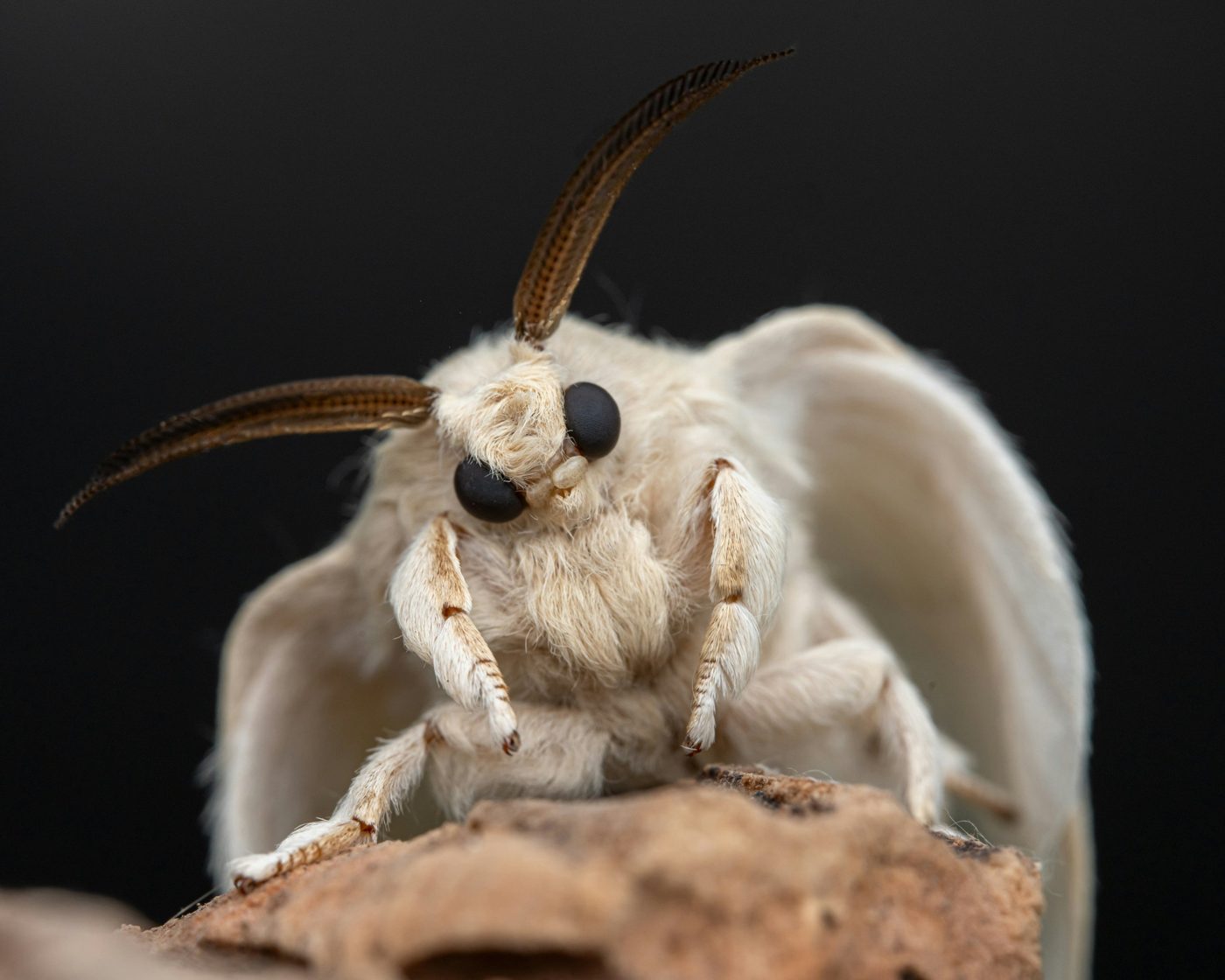
LED and smart lighting have cut CO₂ emissions, but their blue-rich glow and rapid expansion now threaten the very ecosystems we aim to protect. Solving one crisis depends on solving the other. The path forward is adaptive, sustainable lighting guided by biodiversity-aware sensor technology. Only by measuring how nature actually experiences light can we create night-time environments that are safe for species and efficient for cities.



Biodiversity & Light Impact Indexes
Six indexes. One answer per luminaire.
The platform continuously analyses spectral output, intensity, timing and hardware configuration to generate six indexes. Each one returns Compliant or Non-compliant and names the criterion that failed, so the fix stops being a guess.
Ecological Light Pollution Index (ELPI), Mammals
Disruption to nocturnal mammals and rodents from melanopic load, spectrum, UV, flicker and CCT (Lucas et al.).
Insect Attraction Index (IAI)
Donners-style attraction from UV, blue and green spectral bands, intensity, flicker, presence sensor and ULOR.
Spectral G-Index (Sky Glow Contribution)
Contribution to sky glow against the environmental zone (CIE 150, Danish Road Handbook). Lower means less disruption to nocturnal wildlife navigation.
Bat Habitat Disruption (EUROBAT)
EUROBAT-weighted impact on bat foraging and commuting from intensity, spectrum, UV, light below 560 nm, flicker, shielding and timing.
Flora Photoperiod Interference (TPII)
Tree photoperiod disruption from red and blue spectral load against a full-moon baseline, adjusted for curfew, presence, ULOR and BUG.
Circadian / Sleep (Light at Night)
Night-time (23:00 to 07:00) melatonin-suppression risk: melanopic EDI, S-cone EDI and UV exposure.
Inside the platform
Every pole knows what it stands next to.
Developed with Ocutune
VESPER combines the obiWAN Zhaga outdoor lighting controller with the Ocutune light sensor and BioAdaptive platform. Designed with the UN Sustainable Development Goals in mind, it helps cities protect biodiversity, restore natural darkness and support healthier communities.
Answers to the questions
we’re asked most.
Find quick answers to the most common questions about VESPER, the biodiversity-aware Zhaga outdoor lighting controller.
What is VESPER?
VESPER is a Zhaga outdoor lighting controller with a built-in biosensor, developed by obiWAN with Ocutune. It measures how artificial light at night is experienced by wildlife, plants and people, and rates every luminaire against six Biodiversity & Light Impact Indexes.
What does the biosensor measure?
Spectral power distribution, melanopic load, intensity, flicker and UV, directly on the pole. From these readings the platform derives the melanopic and S-cone daylight equivalents, the blue content below 500 nm, the G-Index and the biological daylight efficacy ratios used by the indexes.
Which maps and data layers does the platform use?
Natura 2000 sites (EU/EEA), national protected nature layers, biodiversity score, existing nature, national parks and the NASA Black Marble light pollution map. Each luminaire is also tagged with its CIE 150 environmental zone (E0 to E4) and an SQM sky brightness value.
What are the six Biodiversity & Light Impact Indexes?
Ecological Light Pollution Index for mammals, Insect Attraction Index, Spectral G-Index for sky glow, Bat Habitat Disruption (EUROBAT), Flora Photoperiod Interference and a human Circadian / Sleep index. Each returns Compliant or Non-compliant and names the criterion that failed.
How is VESPER installed?
VESPER fits the Zhaga socket on top of any compatible luminaire, with no rewiring on site. Installation details, connectivity options and the full technical data will be published with the product brief.
Which standards and frameworks are the indexes based on?
CIE 150 and the Danish Road Handbook for environmental zones and sky glow, EUROBAT guidance for bats, Donners-style weighting for insects, melanopic metrics for mammals and people, and the ROLAN manifesto for lighting professionals. VESPER is designed with the UN Sustainable Development Goals in mind.
Who developed VESPER?
VESPER is developed by obiWAN, in Vila Nova de Gaia, Portugal, in partnership with Ocutune, whose light sensor and BioAdaptive platform power the biodiversity analysis.
Request a VESPER pilot today!
Light for people. Darkness for everything else.
- Zhaga node with built-in biosensor
- Six Biodiversity & Light Impact Indexes
- Natura 2000 and light pollution map layers